Retiring in Yunnan, China
Yunnan province in southwest China is one of the country’s most visually dramatic and culturally diverse regions. Bordering Myanmar, Laos, and Vietnam, the province is known for its mild climate, mountain landscapes, ancient tea regions, and slower pace of life compared to China’s major coastal cities.
For Americans curious about living in China, Yunnan is often the most approachable region. Cities like Kunming and Dali offer comfortable climates, lower living costs, and a lifestyle that feels far less overwhelming than megacities like Shanghai or Beijing. At the same time, the province remains deeply Chinese in character, offering a level of cultural immersion many expats find appealing.
However, retiring in China is not as straightforward as retiring in many parts of Europe or Southeast Asia. China does not offer a traditional retirement visa, and property ownership, banking, and long-term residency require careful planning. This guide breaks down the most important factors Americans should understand before considering Yunnan as a retirement destination.
This guide is informational only. Chinese immigration policies change frequently and are strictly enforced. Always consult a qualified immigration professional before making relocation plans.
Where These Cities Are in Yunnan
Yunnan is a large province in southwest China bordering Myanmar, Laos, and Vietnam. The cities discussed in this guide are spread across the province, each offering a slightly different climate, landscape, and lifestyle.
Kunming sits near the center of the province and functions as the main transportation and healthcare hub. Dali lies northwest along the scenic Erhai Lake basin. Yuxi is located just south of Kunming. Pu’er and Lincang are further south toward the tea-growing tropical region near the Laos and Myanmar borders. Baoshan and Tengchong sit in the western mountains near Myanmar.
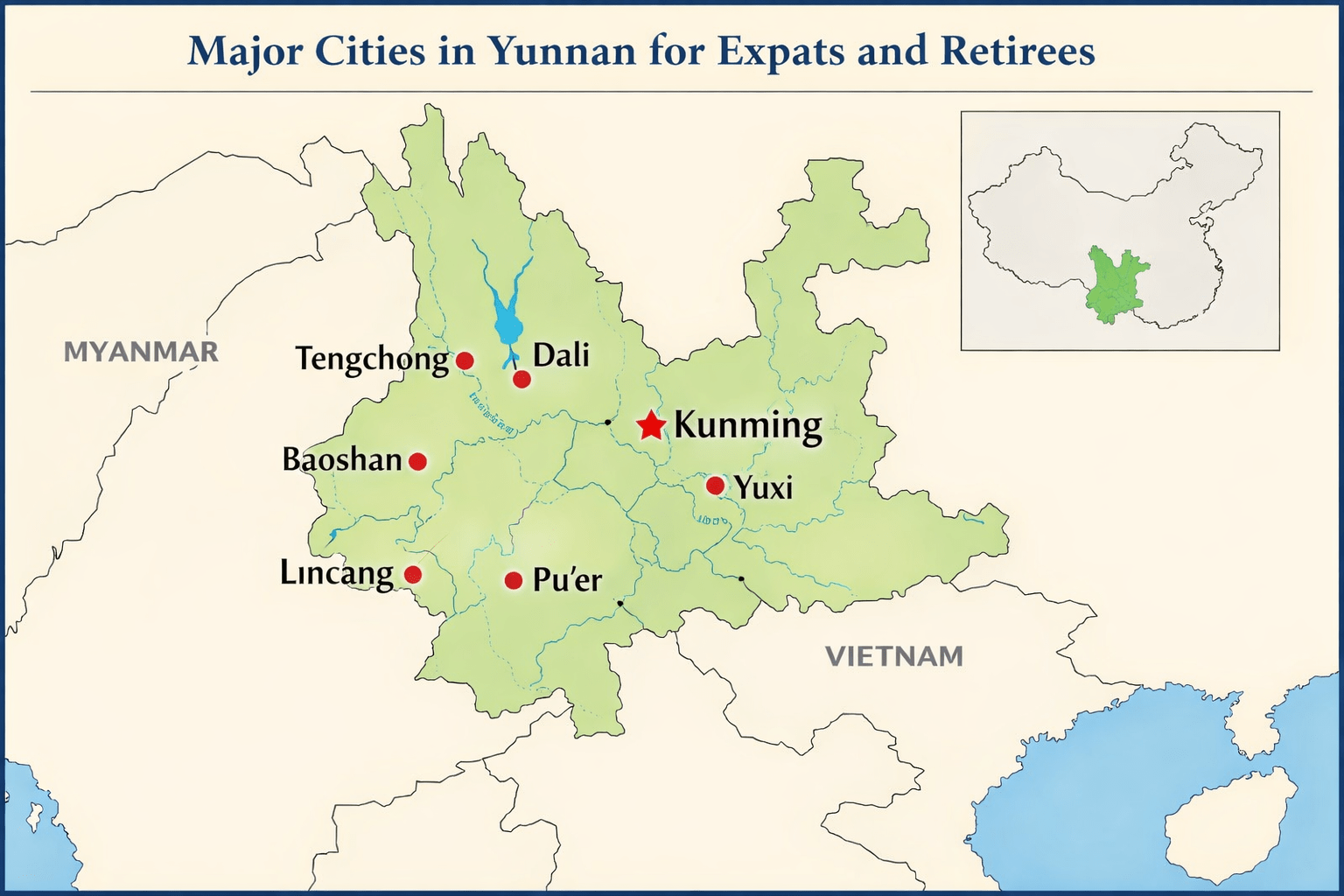
For most foreign retirees, Kunming and Dali are the two most practical entry points into Yunnan. The smaller cities offer lower costs but require greater comfort with local language, culture, and infrastructure limitations.
What It Actually Costs to Live in Yunnan
Yunnan is one of the most affordable parts of China for foreigners who want a milder climate, greener landscapes, and a slower pace than the country’s coastal megacities. The big difference is not whether Yunnan is cheap — it generally is — but which city gives you the best balance of cost, healthcare, climate, and day-to-day convenience.
Kunming — Yunnan’s provincial capital and most practical city — is also its most expensive option for most foreigners. Dali offers a more scenic and lifestyle-driven alternative at slightly lower cost. Smaller cities like Yuxi, Pu’er, Baoshan, and Lincang can be cheaper still, but they come with thinner expat infrastructure and more dependence on local language ability.
The table below reflects realistic monthly costs for one person renting a modern one-bedroom apartment in a decent neighborhood. Couples typically spend about 25 to 40 percent more depending on housing and dining habits.
| City | 1BR Rent | Monthly Cost (1 Person) | Monthly Cost (Couple) |
|---|---|---|---|
| Kunming | $450 – $700 | $1,100 – $1,400 | $1,500 – $2,000 |
| Dali | $350 – $600 | $950 – $1,200 | $1,350 – $1,750 |
| Yuxi | $300 – $500 | $900 – $1,100 | $1,250 – $1,600 |
| Pu’er | $280 – $450 | $850 – $1,050 | $1,200 – $1,500 |
| Baoshan / Tengchong | $300 – $480 | $900 – $1,100 | $1,250 – $1,600 |
| Lincang | $250 – $420 | $800 – $1,000 | $1,100 – $1,400 |
Local food in Yunnan is inexpensive. A simple restaurant meal can cost $2 to $5. A more comfortable dinner for two at a nicer local restaurant often lands in the $15 to $30 range. Imported groceries, Western cafes, and foreign-friendly housing push your real budget up quickly, which is why expat monthly costs are higher than bare local averages.
The bottom line: Kunming is usually the most expensive city in Yunnan, but it earns that premium through stronger hospitals, better transport, and a much easier daily life for foreigners.
Residency and Visa Options for Americans
The most important reality to understand before planning a move is this: China does not have a standard passive-income retirement visa. Unlike countries such as Portugal, Panama, Malaysia, or Thailand, you cannot simply show pension income and obtain a dedicated long-term retirement residence status.
Most Common Long-Stay Paths
- 10-year tourist visa: Many Americans can obtain a long-validity multiple-entry tourist visa, but each stay is limited and this is not the same thing as retirement residency.
- Family reunion residence: The most stable route if you have immediate family ties in China.
- Work or business residence permit: Legally stronger than a tourist visa, but unrealistic for most retirees.
- Permanent residence: Extremely difficult and not a normal retirement pathway for most foreigners.
Practical Reality
Some foreigners spend long periods in China by combining a long-validity tourist visa with repeated exits and re-entries, but this should not be confused with formal retirement residency. It creates uncertainty around leases, banking, healthcare administration, and long-term planning.
Why This Matters More in Smaller Cities
If your legal stay is not robust, you will feel that friction much more strongly in smaller Yunnan cities. Kunming handles these complications better simply because it has the best infrastructure, the largest airport, and the easiest access to consular-style services, hospitals, and transport links.
Can Americans Buy Property in China?
This is one of the biggest differences between China and countries like Albania, Bulgaria, or Thailand: property ownership is not a simple retirement strategy for most foreigners. China regulates foreign property purchases much more tightly, and buying is generally not the first step most retirees should focus on.
In practice, foreigners are usually limited to one residential property for self-use, and eligibility often depends on having the appropriate legal status and local documentation. Buying for passive investment, rental income, or easy retirement use is far more restricted than in most expat-friendly markets.
| Property Issue | Practical Reality in China |
|---|---|
| Buying an apartment | Possible in some cases, but regulated and not automatic for foreigners |
| Buying for investment | Heavily restricted for foreign individuals |
| Owning multiple properties | Generally not allowed for most foreign buyers |
| Using property to gain residency | No standard retirement or property-based residency route |
| Best strategy for retirees | Rent first, learn the system, and delay any purchase decision |
For most Americans considering Yunnan, renting is the rational path. It keeps your legal exposure lower, gives you flexibility if visa rules shift, and prevents you from making an expensive commitment in a country where property ownership does not create retirement security in the way it often does elsewhere.
Healthcare in Yunnan
Healthcare is the single biggest practical divider between Yunnan cities. Kunming is the only city in the province that clearly functions as a strong medical base for foreigners. Dali, Yuxi, and Baoshan can handle many normal situations, but serious or complex care often pushes patients back toward Kunming.
For American retirees, the key issue is not just whether treatment exists — it is whether you can access it easily, communicate effectively, and trust the system for specialist care. That is why Kunming remains the most sensible choice for retirees with medical priorities.
| City | Routine Care | Serious / Complex Care | Practical Assessment |
|---|---|---|---|
| Kunming | Strong | Best in Yunnan | Most suitable for retirees with ongoing medical needs |
| Dali | Adequate | Usually referred to Kunming | Fine for healthy retirees, less ideal for major care |
| Yuxi | Moderate | Usually referred to Kunming | Reasonable if you stay closely linked to Kunming |
| Pu’er | Basic | Limited | Best for healthy, flexible retirees only |
| Baoshan / Tengchong | Moderate | Limited regional capacity | Acceptable for routine needs, not top-tier |
| Lincang | Basic | Limited | Weakest option for older expats with medical concerns |
Medicare generally does not cover routine medical care outside the United States, so anyone considering long stays in Yunnan should plan around private insurance, self-pay care, or an international health policy. Many healthy expats pay cash for routine care and carry broader insurance for emergencies or evacuation.
Climate by City
Climate is one of Yunnan’s biggest advantages, but it varies more than many newcomers expect. Elevation, monsoon season, and local geography create meaningful differences between the province’s main retirement candidates. Some cities stay spring-like for much of the year, while others are warmer, wetter, and more subtropical.
The table below gives a more practical comparison for retirees by showing typical winter lows and summer highs rather than only general descriptions. These are rounded ranges meant to reflect what the climate usually feels like, not exact daily records.
| City | Typical Winter Lows | Typical Summer Highs | Rainy Season | Climate Feel | Overall Climate Fit |
|---|---|---|---|---|---|
| Kunming | 37 – 45°F | 73 – 81°F | June to September | Mild, dry winters and very comfortable summers | Best all-around “eternal spring” climate |
| Dali | 34 – 43°F | 72 – 79°F | June to September | Cooler, breezier, crisp mornings and evenings | Excellent for retirees who prefer cooler air and scenery |
| Yuxi | 41 – 50°F | 77 – 84°F | June to September | Slightly warmer than Kunming, still comfortable | Balanced and comfortable, with a warmer edge |
| Pu’er | 50 – 59°F | 82 – 88°F | May to October | Warm, humid, greener and more subtropical | Best for retirees who want a subtropical climate |
| Baoshan / Tengchong | 43 – 52°F | 79 – 86°F | May to October | Warm mountain climate with mild winters | Strong wellness and mountain-climate appeal |
| Lincang | 52 – 61°F | 81 – 88°F | May to October | Warm, humid, lush, and more tropical-feeling | Warmest and most tropical-feeling option in this guide |
For most Americans, Kunming remains the safest climate recommendation because it avoids both the colder winter mornings of some higher-elevation areas and the heavier humidity found farther south. Dali is often preferred by people who like cooler air and scenery. Pu’er and Lincang make more sense for retirees who actively want warmth, greenery, and a subtropical feel.
Taxes: What Americans Need to Know
China is not usually chosen as a tax-friendly retirement destination. The tax picture is more complicated than in countries that actively court retirees. For Americans, the safest approach is to assume that tax planning needs to be handled carefully before any long-term move.
U.S. Tax Filing Still Continues
As an American, you still file your U.S. tax return annually even if you live abroad. That remains true whether you spend time in Kunming, Dali, or anywhere else in Yunnan.
China Is Not a Passive-Income Retirement Tax Haven
China does not market itself as a pension-tax haven for foreign retirees. Tax treatment can depend on your legal status, length of stay, and the source of your income. This is one reason Yunnan is better approached as a lifestyle destination rather than a tax optimization strategy.
Practical Reality
If you are living primarily on Social Security, pensions, and savings withdrawals, the bigger issue is usually legal stay and banking practicality rather than finding a special Chinese tax advantage. Anyone considering extended time in China should speak with a U.S. expat tax professional before moving money or changing residence patterns.
Free Personalized Guidance
Is Yunnan Right for Your Budget, Climate, and Healthcare Priorities?
Tell us your monthly income, target lifestyle, and how important hospitals, climate, and legal stability are to you. We will help you compare Yunnan with other realistic Asian options.
Start Your Free Assessment →Where to Live in Yunnan
Kunming — Capital, Best Infrastructure
Kunming is the practical choice. It has the best hospitals, strongest transport, biggest airport, most modern housing stock, and the lowest daily friction for foreigners. It is also the most expensive city in Yunnan, but still affordable relative to major U.S. cities and many international retirement destinations.
Dali — Best Lifestyle and Scenery
Dali is the city many people fall in love with. It offers lake-and-mountain scenery, a slower rhythm, a strong visual identity, and more of a lifestyle feel than a capital-city feel. It is a better emotional fit for many retirees than Kunming, but less practical for advanced medical care.
Yuxi — Quiet Alternative Near Kunming
Yuxi is underrated. It is calmer and cheaper than Kunming while still remaining close enough to the capital for specialist care and transport. For retirees who want peace without complete isolation, it may be one of the strongest value plays in Yunnan.
Pu’er — Warm, Green, and Tea-Centered
Pu’er is warmer and more tropical than the plateau cities. It is ideal for retirees who like greenery, tea culture, and a quiet southern atmosphere. It is affordable, but foreign-facing infrastructure is thin and healthcare is much more local.
Baoshan / Tengchong — Hot Springs and Mountain Air
Western Yunnan has a different feel from the central plateau. Tengchong is known for geothermal hot springs, volcanic landscapes, and cleaner mountain air. It is compelling for wellness-minded retirees, but less convenient than Kunming for serious logistics.
Lincang — Lowest Cost, Highest Adaptation Requirement
Lincang is the lowest-cost option in this comparison and also the most immersive. It is best suited to retirees who are highly independent, comfortable with limited English support, and willing to trade convenience for cost savings and a more local Chinese environment.
| City | Climate | Best For | Main Tradeoff |
|---|---|---|---|
| Kunming | Mildest overall | Infrastructure, hospitals, practicality | Highest cost in Yunnan |
| Dali | Cooler, scenic, breezier | Lifestyle, scenery, walkability | Less medical depth |
| Yuxi | Slightly warmer than Kunming | Quiet living near the capital | Smaller expat ecosystem |
| Pu’er | Warmer, greener, wetter | Tea region lifestyle, subtropical feel | Thin foreign infrastructure |
| Baoshan / Tengchong | Warm mountain climate | Nature, hot springs, wellness | More isolated |
| Lincang | Warm and subtropical | Lowest cost, deep immersion | Most difficult for foreigners |
Practical Details
Language
Mandarin matters. In Kunming you can get by more easily with translation apps and limited local-language ability. In smaller cities like Pu’er and Lincang, daily life without conversational Chinese becomes much harder.
Transportation
Kunming is Yunnan’s transport hub with the province’s main international airport and strongest rail connections. Dali is well connected regionally. The smaller cities are workable, but much less convenient if you need frequent travel or emergency movement.
Banking and Digital Payments
Daily life in China is heavily digital. Banking, mobile payments, and account access can be much easier with stronger legal residency status than with repeated tourist entries. This is one of the hidden frustrations that retirees often underestimate.
Safety
Yunnan is generally very safe in terms of violent crime. The bigger challenges for retirees are administrative complexity, language barriers, healthcare access, and the lack of a straightforward retirement residency path.
Climate Fit
If you want the classic “eternal spring” climate, Kunming remains the benchmark. If you want beauty and lifestyle first, Dali is hard to beat. If you want warmth and a more tropical feel, look south toward Pu’er and Lincang.
Frequently Asked Questions
For most retirees, Kunming is the best all-around choice because it combines the best hospitals, easiest transport, and strongest foreigner-friendly infrastructure. Dali is usually the best lifestyle choice if scenery matters more than functionality.
Yes. Kunming is usually the most expensive city in Yunnan for foreigners because it is the provincial capital and the main healthcare and transport hub. Even so, it remains much cheaper than major U.S. or coastal Chinese cities.
No. China does not offer a standard passive-income retirement visa. Most long-term foreign stays rely on other legal paths such as family-based residency, work-related permits, or repeated tourist-visa use.
Usually yes. Dali is generally cheaper on housing and daily life, but the difference is not dramatic enough to matter more than infrastructure for many retirees.
Property ownership for foreigners in China is regulated and typically limited. For most retirees, renting first is the safer and more realistic path.
Kunming is the most balanced and famously mild year-round. Dali is cooler and more scenic. Pu’er and Lincang are warmer and more humid with a stronger subtropical feel.